
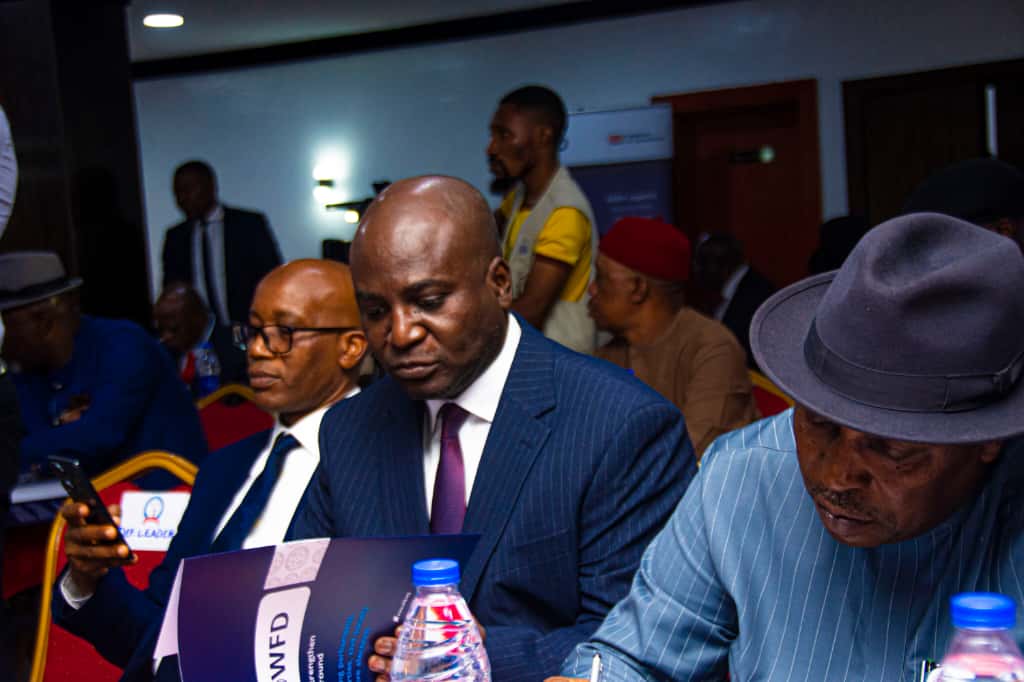
The Attorney-General and Commissioner for Justice, Ekemejero Ohwovoriole, SAN, has described Post-Legislative Scrutiny (PLS) as an essential tool for strengthening legislative practice and ensuring that laws truly serve the people.
Ohwovoriole stated this in Asaba at a workshop organised by the Westminster Foundation for Democracy (WFD) in partnership with the Delta State House of Assembly.
In his remarks, the Attorney-General explained that Post-Legislative Scrutiny provides a structured way to determine whether laws are being effectively implemented and delivering the benefits intended by lawmakers.
“It is about looking beyond the passage of a bill to understand how it performs in the real world,” he said.

He noted that Delta State had long recognised the importance of this mechanism, which informed the Ministry of Justice’s decision to appoint a law officer to act as liaison to the House of Assembly, enhancing collaboration and enabling continuous monitoring of the performance and impact of state laws.
Highlighting practical examples, the Attorney-General pointed out that some laws, once implemented, fail to achieve their intended aims. This, he said, underscores the necessity of PLS.
“It gives us the opportunity to step back and ask whether the law is working as intended,” he added.
According to him, reviewing implementation outcomes would help strengthen enforcement, improve funding for support services, and deepen collaboration with NGOs and civil society, ultimately ensuring that laws positively impact citizens’ lives.
To make the initiative sustainable, Ohwovoriole urged the House of Assembly to adopt a formal Post-Legislative Scrutiny framework. He suggested that the framework should focus on a selected number of laws each year to allow for thorough and meaningful review.
He also emphasised the need to recognise existing structures that already support legislative improvement.
He cited the Delta State Law Revision Committee established under the Law Revision Committee Law, 2002 as a key institution responsible for collating, revising, and updating all laws applicable in the state.The committee, he said, ensures that state laws remain accurate, consistent, and up-to-date by removing obsolete provisions, consolidating related laws, correcting drafting errors, and aligning legislation with constitutional and administrative realities.
According to Ohwovoriole, while the Law Revision Committee focuses on technical updates, Post-Legislative Scrutiny evaluates the real-life performance of laws making both processes complementary.
“They work in harmony to create a continuous cycle of reflection, reform, and renewal, keeping our laws relevant and effective in advancing the M.O.R.E. Agenda,” he said.
He further recommended that Ministries, Departments, and Agencies (MDAs) be mandated to prepare and submit annual implementation reports on the laws under their purview, detailing successes, challenges, and required support for improved enforcement.
The Attorney-General commended the Westminster Foundation for Democracy for its consistent support in strengthening legislative excellence across Nigeria through research, capacity-building, and technical assistance.