
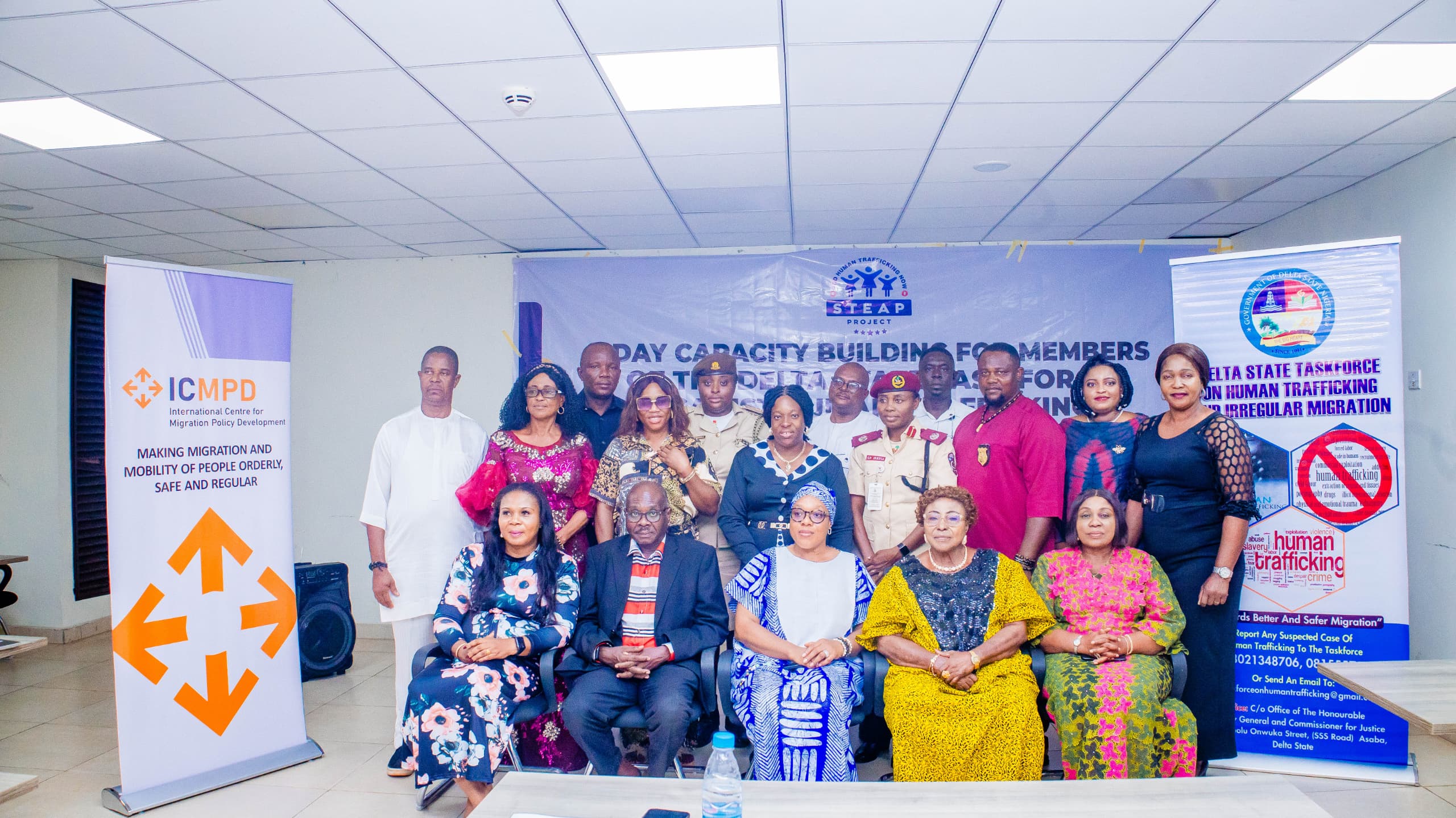
The International Centre for Migration Policy Development (ICMPD), in collaboration with the National Agency for the Prohibition of Trafficking in Persons (NAPTIP), has scaled up strategies and approaches aimed at tackling human trafficking in Delta State through a two-day capacity-building workshop for members of the Delta State Taskforce on Human Trafficking.
The organisers noted that the complex and evolving nature of human trafficking across the country requires expertise, diligent investigation, and effective prosecution strategies to outsmart traffickers and dismantle their networks.
Declaring the workshop open, the Delta State Attorney-General and Commissioner for Justice, Ekemejero Ohwovoriole, represented by the Head of the Anti-Human Trafficking Unit, Delta State Ministry of Justice, and Secretary of the Delta State Taskforce on Human Trafficking and Irregular Migration, Ijeoma Nwanze, explained that the taskforce was established as a strategic instrument to coordinate counter-trafficking efforts at the state level.
She added that the workshop was designed to equip taskforce members with knowledge of emerging tactics and deceptive methods traffickers use daily to lure victims.
The workshop was organised by International Centre for Migration Policy Development in partnership with National Agency for the Prohibition of Trafficking in Persons, with support from the Kingdom of the Netherlands under the Schools Anti-Trafficking Education and Advocacy Project (STEAP).
Delivering a lecture at the workshop, Tonia Mgbemeje took participants through international, national, and state laws on human trafficking, victim identification and profiling, red flags, trauma-informed questioning, profiling techniques, and trauma response mechanisms.
Speaking during the workshop, the STEAP project officer, ICPMD, Ijeoma David-Ukolo said migration among developing countries has become a growing concern due to the increasing risks of human trafficking and irregular migration.
She explained that ICMPD, with support from the Government of the Netherlands, is implementing the Student Anti-Trafficking Education and Advocacy Project (STEAP) to educate children, students, and young people on the dangers of trafficking and irregular migration.
According to her, the initiative also involves teachers, parents, PTAs, and community leaders in awareness campaigns. She disclosed that the project is currently being implemented in 15 schools across five Nigerian states, including Delta State, Edo State, Ogun State, and Osun State, which were identified as vulnerable areas through research findings and United Nations reports.
She further stated that the initiative was informed by years of research and baseline studies which revealed increasing cases of drug abuse and human trafficking, issues the United Nations has described as reaching alarming levels. While earlier interventions focused mainly on drug awareness, the programme has now expanded to address human trafficking and other social challenges affecting young people.
In Delta State, she said the strategy is school-based and people-centred, with strong emphasis on education and early awareness. The Nigerian Educational Research and Development Council has integrated anti-trafficking topics into the secondary school curriculum, while teachers have also been trained to effectively teach the subjects.
To further strengthen awareness, NAPTIP established anti-trafficking and violence prevention clubs in schools across the state. The clubs educate students on the signs and dangers of trafficking and encourage peer-to-peer advocacy within communities.
She disclosed that about 25 schools have so far benefited from the initiative in Delta State with schools grouped into clusters to ensure sustainability and gradual expansion of the programme.
The programme also supports participating schools with small-scale infrastructural interventions identified by school administrators, thereby promoting ownership and creating a more conducive learning environment.