

Delta State is doubling down on criminal justice reforms after emerging the top-performing state in Nigeria with a 90.9% compliance score in the implementation of the Administration of Criminal Justice Laws (ACJLs).
The renewed commitment was announced at a one-day capacity-building workshop in Asaba, organised by the Centre for Socio-Legal Studies (CSLS) with support from the MacArthur Foundation.
The session brought together judges, lawyers, security agencies, and other justice sector stakeholders to examine the National Minimum Standards (NMS) designed to harmonise how states implement both the federal Administration of Criminal Justice Act (ACJA) and their own ACJLs.
Speaking on behalf of CSLS, the President/Executive Director, Prof. Yemi Akinseye-George—represented by Executive Assistant Oyinloye Opajobi emphasised the need for uniformity across the country.
“We can’t claim to have a fair justice system if the same crime attracts different punishments in different states. The NMS sets the baseline. States can go above it, but not below it,” he said, noting that the framework covers pre-trial, trial, and post-trial processes.
Delta State’s influence on criminal justice reforms nationwide was also highlighted, with several provisions in its ACJL reportedly more progressive than those in the federal ACJA.
 However, Prof. Akinseye-George cautioned that a decade after the ACJA came into force, significant enforcement gaps persist. He called for a more pragmatic approach backed by a healthy inter-state competition to drive progress.
Chairman of the Delta ACJMC Monitoring Committee, Justice Godwin Briki-Okolosi, drew attention to real-life cases showing widespread misinterpretations of the law by legal practitioners and law enforcement officers. He stressed the urgent need for targeted training across all arms of the justice system.
“Synergy among all operators of this law is non-negotiable. Everyone from the bench to the correctional service must understand their role if justice is to be truly corrective, not punitive,” he said.
The Ministry of Justice, represented by Director of Public Prosecutions, Anthony Orhorhoro, noted that the state has already recorded tangible improvements. Delta’s custodial population, he said, dropped from 2,399 inmates in March 2022 to 1,245 in July 2025, aided by measures such as virtual court hearings now operational in the Ogwashi-Uku and Warri custodial centres.
“Our adoption of the ACJL in 2016 and its amendment in 2022 show our resolve. We are passionate about meeting and even surpassing the national minimum standards,” Orhorhoro said.
Director of the Office of the Public Defender, Ernest Edomwonyi, added that justice reforms must translate into real improvements for the ordinary person.
“When one link in the justice chain is weak, the whole system suffers. This workshop is our chance to strengthen those links and restore public trust,” he said.
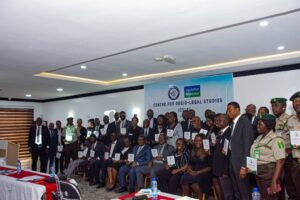 The workshop featured plenary discussions and interactive breakout sessions where participants explored strategies for improving uniform enforcement of the law, reducing pre-trial detention, expanding legal aid, and enhancing monitoring mechanisms across the justice sector.